
The model recognizes the tooth. What it can't do is count.
A Point Transformer numbers 93% of teeth from surface geometry alone. Almost every failure is the same one: the right tooth with the number shifted by one position.
An intraoral scanner produces a 3D mesh of the mouth: roughly 117,000 points per arch. The goal of this experiment was to label every point with the tooth it belongs to, in FDI notation, the two-digit system where the first digit indicates the quadrant of the mouth and the second the position of the tooth. It sounds like a simple problem: point cloud semantic segmentation is a mature field these days, with good architectures and public datasets. In my case I set up a Point Transformer on Teeth3DS+ (300 patients, 600 arches) and expected the interesting part to be tuning the metric. It turned out to be something else.
First finding: geometry is enough
The question I wanted to answer wasn’t “how accurate is it?”, but an architecture decision: do we need CBCT to number teeth? CBCT, which not everyone will know, is a type of dental CT scan, a modern version specific to the mouth and face that produces 3D images with less radiation than a standard hospital CT. The thing is that integrating it is expensive: it requires registering volume and mesh with sub-millimeter precision, and having both modalities from the same patient.
The result: with surface geometry alone, the model gets the FDI number right for 93% of teeth. The feature that achieves this is the normals, the vector perpendicular to the surface at each point. Three numbers per vertex, computed in seconds, at no acquisition cost. And something even more useful: the model without any per-point feature collapses. It learns the training set and generalizes nothing, because without a descriptor of the local shape it latches onto the absolute position of the point within the arch, and every mouth has a different shape.
Second finding: the failure isn’t recognizing, it’s counting
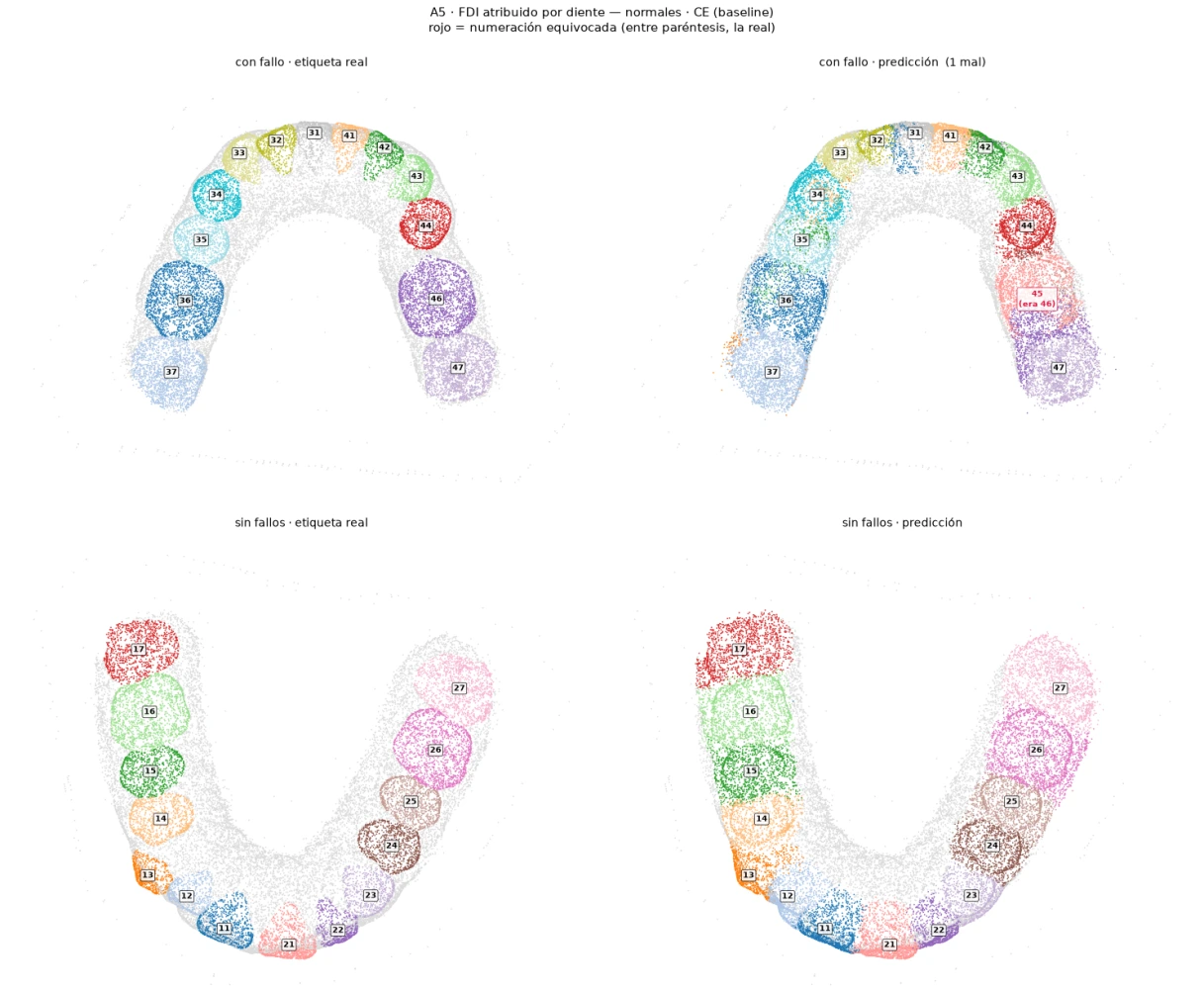
This is where the problem stopped resembling what I thought it was. I looked at what it was getting wrong, and the dominant error wasn’t random. 62–83% of the failures are the tooth next door (a 46 labeled as a 45), and it isn’t a badly drawn boundary, it’s the whole tooth, correctly detected and correctly delimited, with the number shifted by one position. The rest of the arch, perfect.
The reason was in the notation: FDI is ordinal, and as I mentioned at the start, the second digit is how many positions you’ve counted from the midline: 1 the central incisor, 2 the lateral, 3 the canine, and so on. To say “this is a 46” you have to know which quadrant you’re in and that it’s the sixth counting from the center. That is counting, and counting requires seeing the whole sequence. But the model looks at local neighborhoods, precisely what allows it to generalize across patients. The problem is that a first molar and a second molar are almost identical in shape, so locally there’s nothing to distinguish a 46 from a 47. So the model infers the ordinal from a fuzzy estimate of “how far along the arch am I”. If that estimate shifts by one slot, the number shifts by one slot.
What confirms the hypothesis: the error gets worse with missing teeth (0.86 versus 0.98 in complete dentitions). If a tooth is missing, the counting reference breaks — and an intraoral scan cannot see a missing tooth, nor an impacted, unerupted one; it only captures the surface visible in the mouth. So what’s needed is global context of the arch, and that has to come from another source: a panoramic radiograph, the CBCT, or the clinical report itself. The model knows what each tooth is, but fails at where it sits in the sequence.
Third finding: the uncomfortable one
I spent several weeks drawing conclusions from single runs. Train, measure, note the result, move on. But when I switched everything to three seeds with mean and standard deviation, I discovered that the variance between runs was of the same order as the effects I was measuring. It wasn’t that the numbers moved a little, the sign changed. A technique I had documented as a supposedly modest but consistent improvement gave, across five runs of the same code, deltas of +0.034, −0.048, −0.035, +0.017 and −0.116. These weren’t conflicting results; they were samples from a distribution centered on zero, which means I had been describing noise.
And after several rounds something else surfaced: the training isn’t even reliable. One seed produced a model that never learned to tell upper jaw from lower: it got 79% right on top and 19% on the bottom, systematically mapping the lower teeth onto upper codes. That model would have gone unnoticed if I had only looked at the global metric from a single pass.
The conclusion I take from all this could be summed up as: a well-measured negative result is worth more than a badly measured positive one, knowing that a technique doesn’t help at this scale saves the time of building on top of it. Before optimizing, it’s worth understanding the structure of the error. The 93% was the presentable number. The useful finding was that the failures are systematic and of a single type, because that tells you exactly where to put the human review: the molar region and mouths with missing teeth.
Experiment on Teeth3DS+. This is not a clinical result: it’s a technical spike on one dataset and one type of scanner, and it serves to decide architecture, not to diagnose. This experiment is part of an exercise proposed by Matías Molinas, within ANFAIA’s Agentic-Smart-Health project, in collaboration with Histora.