
We scanned the same mouth twice, minutes apart. The software reported a 2 mm tooth movement.
Nothing had moved between the two scans, so every millimetre the pipeline reported was noise. Measuring the noise first is what turns a displacement figure into something you can act on.
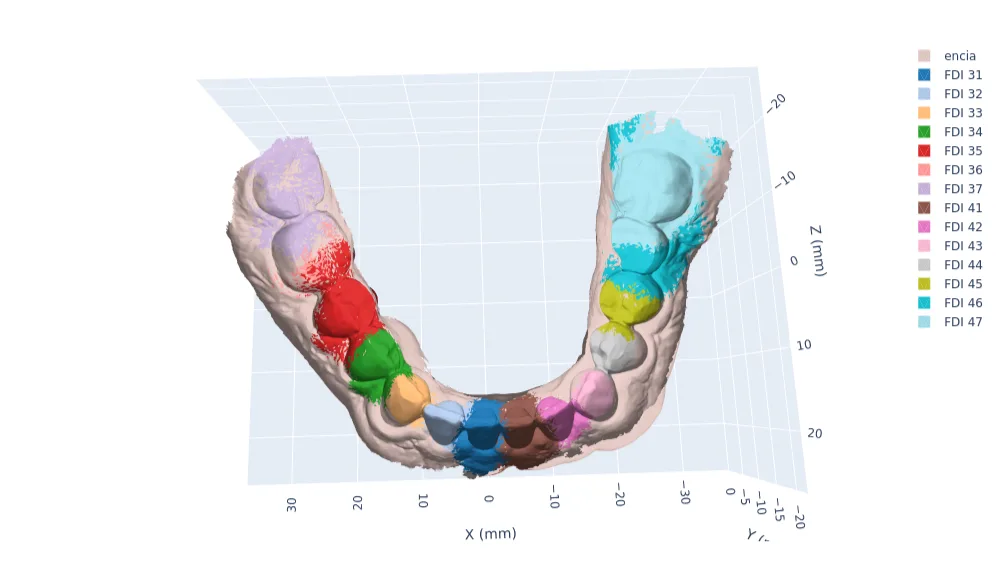
Nothing had moved. Same patient, same appointment, same scanner, two consecutive acquisitions. No biology changed between them. No calculus was removed. Any displacement measured from that pair is false by construction — it’s pure measurement noise.
The standard whole-arch superimposition reported a median of 1.36 mm, with one tooth at 2.03 mm. Two millimetres isn’t a rounding error. It’s the order of a displacement that would make a clinician act.
Why this happens
Intraoral scanners are excellent — they resolve surface geometry well under a tenth of a millimetre. So comparing two scans over time feels like it should just work. The problem isn’t the scanner. It’s that an intraoral scan contains nothing fixed.
In a CBCT you have the cranial base: a structure that doesn’t move, against which everything else is measured. An intraoral scan has no equivalent. Every tooth in the field can move, and the gingiva changes shape between visits through inflammation, recession, or simply having deposits removed.
So displacement can only be expressed relative to the rest of the arch — and how you define “the rest of the arch” changes the answer. The conventional approach registers the whole arch and measures each tooth against that fit. Two things go wrong in the output:
- The tooth sits inside its own reference. If it moves, it drags the frame with it — under-reporting itself and over-reporting its neighbours.
- The gingiva is in the reference too. Soft tissue motion goes straight into the frame everything is measured against.
A small change with a large effect
To measure a given tooth, fit the reference frame from every other labelled tooth, and exclude gingiva entirely. We tested both frames at two registration settings, to see how much each depended on a hyperparameter nobody reports:
- Whole-arch reference: median displacement swings from 0.17 to 0.74 mm — a factor of 4.3
- Leave-one-out reference: 0.16 to 0.18 mm — a factor of 1.2
The worst-affected tooth moves by 0.70 mm under the conventional frame purely from changing that setting. Under leave-one-out, 0.11 mm — below the measurement’s own residual.
But stability isn’t the point. The null control is. Here’s the part I’d argue matters most, and it costs almost nothing: Scan the patient twice at the same visit. Nothing can have changed between those two scans. So whatever the method reports is noise — and now you know your noise threshold. For this scanner and protocol, that threshold is about 0.4 mm. Below it, we don’t say a tooth moved.
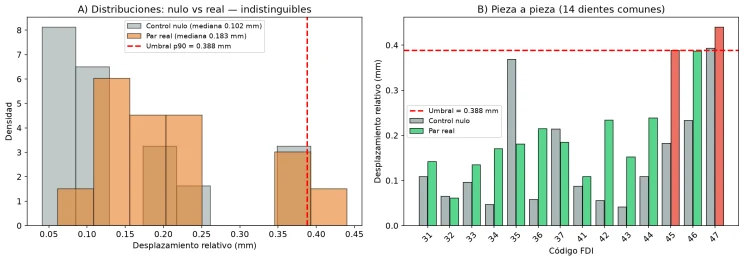
One thing worth stating plainly: at the tighter setting, the conventional frame is actually better (0.30 vs 0.39 mm). It doesn’t lose everywhere. What disqualifies it is that its performance depends on a value you can’t know in advance. The leave-one-out frame wins by not depending on the setting — which is what makes a threshold quotable at all.
And a trap we fell into first: a pre/post-hygiene pair is not a null control. Hygiene doesn’t move teeth, but it removes calculus, so the surface genuinely changes and registration correctly reports a difference.
What I’d take away
Right now, a displacement figure from intraoral scans is uninterpretable without two things that are almost never reported: which reference frame produced it, and what that frame reports on a repeat scan of an unchanged mouth.
The second one is a few minutes of chair time. It converts every subsequent comparison from an unbounded claim into one bounded by a stated detection limit. Without it, you’re publishing a number without knowing whether it means anything.
Caveats, stated up front
This is one patient — a proof of concept for the method, not a clinical study. The 0.4 mm value belongs to this arch. What generalises is the procedure for finding your own.
We also can’t speak to sensitivity: the null control tells you what the method reports when displacement is zero, not whether a real 0.5 mm movement would be recovered accurately. That’s a separate experiment.
Part of ongoing work on dental digital twins. Happy to share the methodology in more detail — the full write-up includes the registration pipeline and three negative results that didn’t make this post.